What Friendship Stories Actually Do for a Preschooler’s Growing Mind
Benefits of friendship stories for preschoolers
A three year old cannot tell you why she felt left out when her friend ran off with someone else at the park. A four year old cannot explain why he forgave his best friend five minutes after a shouting match over a toy. But both of them can sit through a story about exactly that happening to someone else, and something in that quiet listening does real work. The benefits of friendship stories for preschoolers go well past teaching kids to share. They touch how a young child’s brain starts to understand that other people have thoughts and feelings separate from their own, how a child gets words for the storm going on inside them, and how a child learns, safely and at a distance, what happens after a fight.
How Preschoolers Learn to Understand Other Minds Through Story
Theory of mind is the term psychologists use for a skill that sounds obvious to adults and is genuinely hard for a young child: understanding that another person can think, want, or believe something different from what you think, want, or believe. A toddler assumes everyone sees the world exactly as she does. A preschooler is in the middle of figuring out that this is not true, and that process usually isn’t finished until somewhere around age four or five.
Friendship stories give a child practice at this without the pressure of a real social moment happening in real time. When a character in a story feels nervous about joining a game, or misunderstands a friend’s joke, the child listening gets to sit outside the situation and consider what that character is thinking, separate from what the child themselves would think. A parent asking “why do you think she looked sad there?” during a pause in the story is asking a child to step into someone else’s head, which is precisely the muscle theory of mind depends on.
This is part of why stories built around a cast of distinct characters, each reacting differently to the same event, tend to do more for this skill than a single character having an adventure alone. A tale like Pip the Penguin’s Party works well here, since a party setting naturally puts several characters’ feelings on display at once, giving a child several minds to compare rather than just one.
Give Children Words for Feelings They Can’t Name Yet
Ask a three year old how he feels and you will often get “bad” or “not good” or nothing at all. The feeling is there. The word for it is not, at least not yet. Preschoolers are still building the vocabulary that lets them sort a general sense of unease into something more specific: embarrassed, left out, jealous, disappointed, relieved.
Stories hand children that vocabulary in a low-stakes way. A character who is “cross because her friend didn’t wait for her” gives a listening child a label that can later be pulled out and applied to their own experience. Hearing a character described as feeling “shy” or “proud” or “sorry” plants words that a child may not produce on cue but will recognize and eventually use.
This matters more than it might first appear. A child who has a word for a feeling has a way to communicate it instead of acting it out through a tantrum or a shove. Naming an emotion is one of the few things known to actually calm the nervous system response that goes with it, which is part of why adults are told to “name it to tame it” with young children. Friendship stories are, in effect, a slow, repeated stocking of the emotional shelf a child will need later.
Stories set around shared activities tend to generate a wide range of this vocabulary because so much can go right or wrong socially during a single outing. Friends at the Fairground and Beach Day with Friends both put characters through small social ups and downs, excitement, impatience, disappointment, relief, that give a child plenty of feeling words to pick up across one sitting.
Rehearse Conflict and Repair in a Safe, Fictional Space
Real conflict between preschoolers is loud, fast, and often over before an adult has worked out what happened. There is rarely time in the moment for a three or four year old to think clearly about what went wrong or what making up might look like. A story slows all of that down.
When two characters in a book argue over whose turn it is, then work it out, a child gets to watch the whole arc: the disagreement, the uncomfortable middle part, and the return to friendship. Because the child is not the one who did the shoving or the one who got shoved, there is no defensiveness in the way. They can watch the repair happen clearly, which is often harder to do when a child is the one inside the conflict.
This rehearsal matters because repair is a skill, not an instinct. Children are not born knowing how to apologize or how to accept one. They learn it the way they learn most things at this age, through repeated exposure and example. A story that shows a disagreement resolving, rather than skipping straight to everyone being friends again, gives a child a model for the steps in between.
Stories built around a group with ongoing friction and resolution, like Camping with Best Buddies or Freddy Fox’s Fantastic Friends, tend to work well here because the characters are established enough that a small conflict doesn’t threaten the whole friendship in the child’s mind. The child already trusts, from earlier in the book or from prior reads, that these characters like each other, which frees them to focus on how the conflict gets sorted out rather than worrying whether the friendship survives.
Why Reading the Same Friendship Tale Again and Again Builds Security
Parents often wonder if there’s something wrong with a child who wants the exact same book read for the fifteenth night running. There isn’t. Repetition is doing real work for a preschooler, who is still building the kind of predictive understanding of a story that adults take for granted.
The first few readings of any story are partly spent just following what happens. By the tenth reading, a child already knows what comes next, and that knowledge frees up mental space to think about why it happens, how a character feels, and what they would do differently. Familiarity is what lets the deeper processing happen. A brand new story every night, however well chosen, never gets the chance to be mined this deeply.
There is also a simple comfort function. A story a child already knows well, including knowing that the friends in it make up by the end, is reassuring precisely because the outcome is certain. That certainty is part of what makes a repeated friendship story useful rehearsal: the child isn’t anxious about how it will end, so they can pay closer attention to the feelings along the way.
Use Friendship Stories to Ease Big Transitions Like Starting School
A big transition, like starting preschool or moving up to a new classroom, asks a child to do something that feels enormous from the inside: walk into a room full of people they do not know and figure out how to become friends with some of them. Adults manage this kind of thing by drawing on years of social experience. A preschooler has almost none of that to draw on yet.
A story set in a similar situation gives a child a kind of map before they need it. If a character in a book feels nervous on the first day, then finds one friendly face, then slowly becomes part of a group, a child who is about to live through something similar has already seen the shape of how it can go. That doesn’t remove the nerves, but it gives the child a reference point for what’s coming, which tends to reduce the sense that the unknown is limitless.
If a transition like this is coming up for your child, First School Days for Little Ones was written with exactly this kind of lead up to a new setting in mind.
Signs a Story Is Actually Landing With Your Child
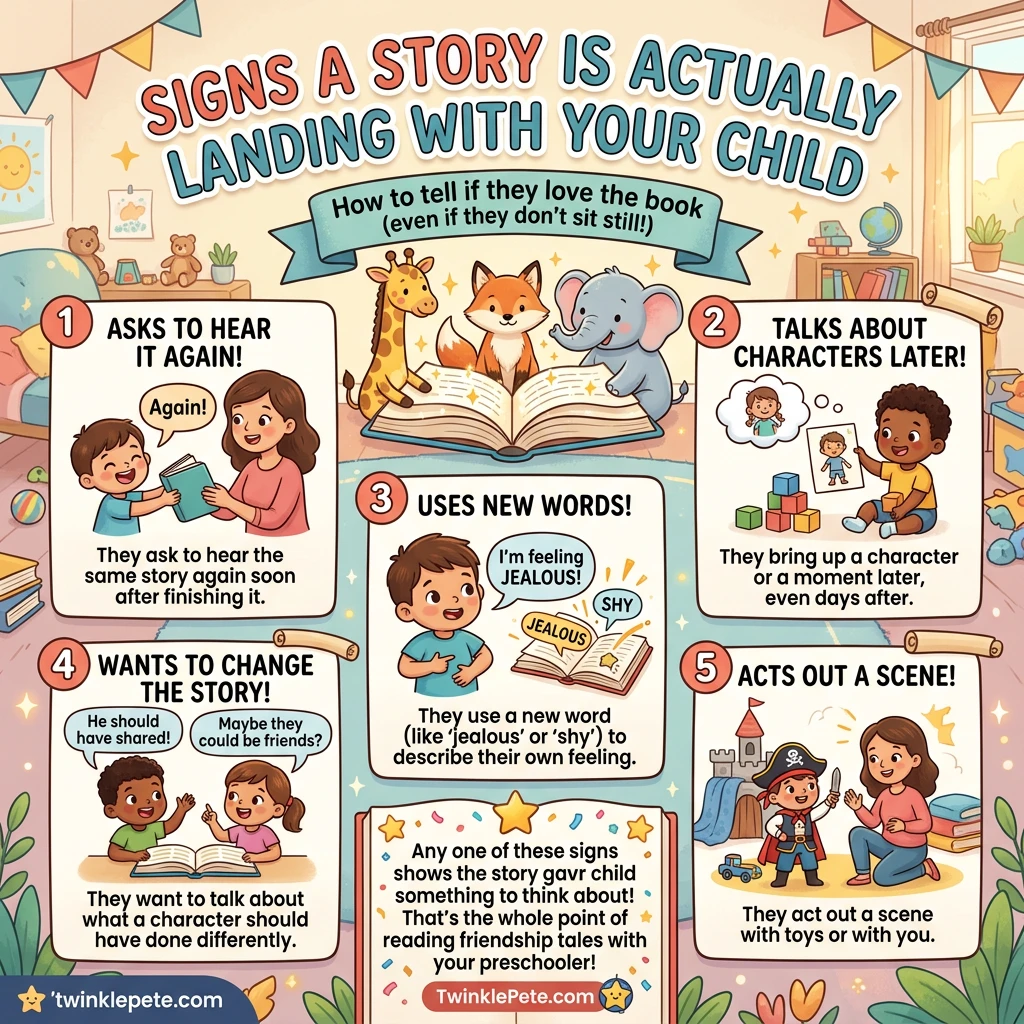
Not every story will hit the same way for every child, and it helps to know what engagement actually looks like at this age, since it is rarely a child sitting perfectly still.
- They ask to hear the same story again soon after finishing it.
- They bring up a character or a moment from the book later, outside of story time, sometimes days later.
- They use a word from the story, like “jealous” or “shy,” to describe their own feeling in an unrelated moment.
- They want to talk about what a character should have done differently.
- They act out a scene from the story with toys or with you.
Any one of these is a sign the story has given your child something to chew on, which is really the whole point of reading a friendship tale with a preschooler in the first place.
If your little one is facing a big change soon, try reading First School Days for Little Ones together this week and watch how they talk about it afterward.
Related Posts