Simple Props for Telling Tales at Home
Storytelling props for toddlers at home can be as simple as three smooth stones and a lamp pointed at a wall. A stone gives a small child something to look at and hold while they listen, and a hand shadow gives them a moving character without a screen or a single page to read.
This guide is for parents and educators of children who cannot read yet. Everything here uses things already in your home, and every idea works for one child on your lap or a few on a rug.
What are story stones and shadow puppets, and why do they work for little ones?
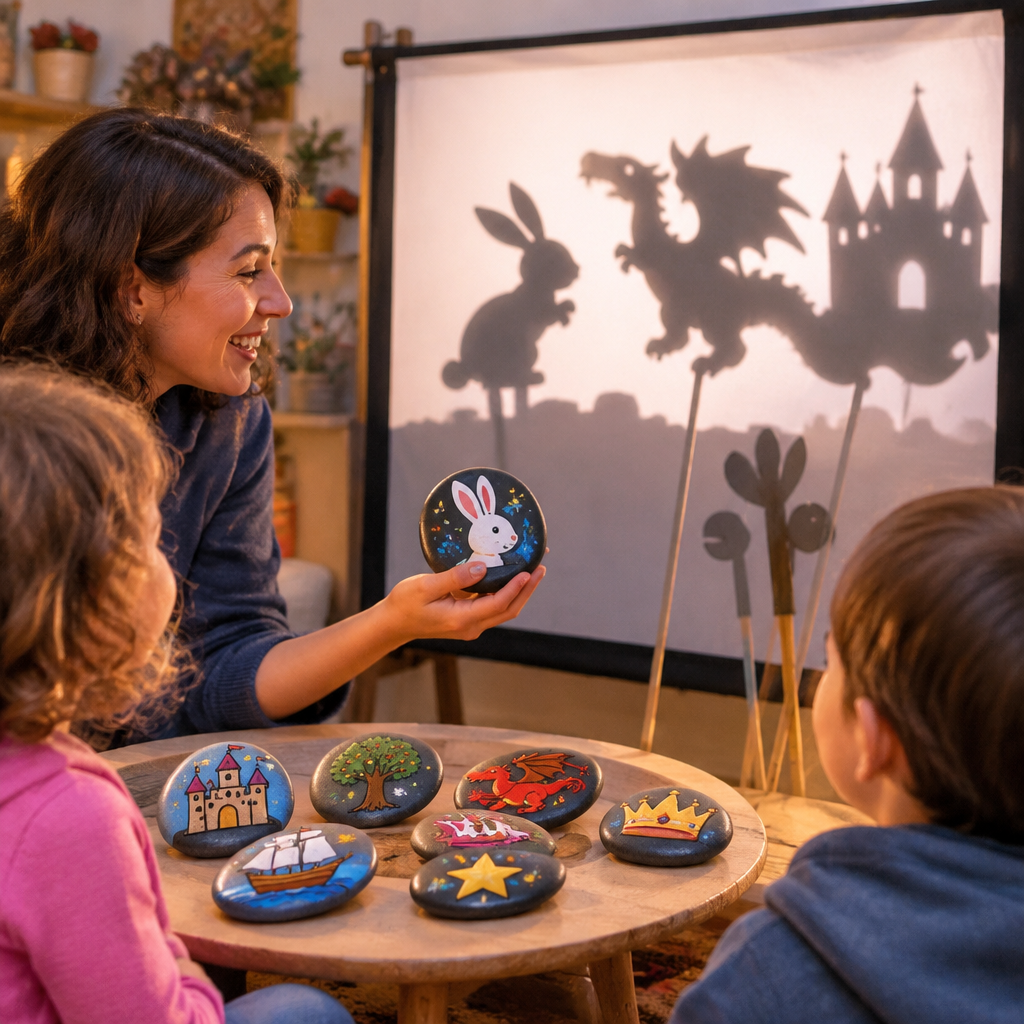
Story stones are small, smooth stones, each marked with a simple picture such as a sun, a bird, a house or a heart. You choose a few, set them in front of the child, and let each stone stand for one part of the tale. Shadow puppets are shapes your hands make in front of a light, so that a bird or a rabbit appears on the wall and moves while you talk.
Both work for the same reasons. A child who cannot read follows a story through what they hear and see, and a small object gives the eyes a place to rest while the ears do the work. A stone also stays still, so a very young listener can look at it, touch it and come back to it, which a spoken sentence cannot do.
The wall adds something different. A dim room and a soft shadow slow everyone down. Voices drop, shoulders loosen, and the story feels like a shared moment rather than a performance.
Neither prop needs skill. You do not have to draw well or perform voices. A few words, a gentle pace and something to look at are enough.
How do you make story stones with things you already have?
Start with the stones themselves. Flat, smooth stones from a garden path, a beach walk or a flower bed work well. Choose stones that are clearly too big to fit in a child’s mouth, wash them, and let them dry fully.
Then add the pictures. You have several choices.
- Draw on each stone with a permanent marker or a paint pen, using very simple shapes.
- Paint a plain shape with non-toxic paint and let it dry before telling.
- Use chalk for a quick picture that wipes off, which suits a small group where you want to change the pictures each week.
If you have no stones, cut rounds from cardboard and draw on those with crayons. They are light, they cost nothing, and a child cannot hurt a foot or a window with them.
Keep the pictures plain. A circle with rays is a sun, a curved line is a bird, a heart is a friend. Toddlers read shapes with their whole attention, and a simple picture leaves room for them to decide what it means. Eight to ten stones is plenty for a basket, and you only need to use three at a time.
Stay close whenever stones are out. Even large stones are for watching and holding together, not for carrying around the house on their own.
How do you tell a story with just three stones?
Three stones give a story a beginning, a middle and an end, which is all a very young listener needs. Pick them before you sit down, or let the child pull them from the basket without looking.
Here is a simple way to use them.
- Put the first stone down and say who the story is about. “Here is a little bird.”
- Put the second stone down and say what happens or what is wanted. “The bird wanted to find the sun.”
- Put the third stone down and finish gently. “And the sun was waiting, warm and glad.”
Say each part slowly, then pause. Toddlers often fill the pause with a word, a sound or a point of the finger, and that is a good sign. They are inside the story with you.
You can move the stones as you speak. Slide the bird stone toward the sun stone while you tell the journey. Let the stones touch at the happy part. The movement does what a longer description would do, and it keeps your telling short.
Keep the tale to a minute or two the first few times. A short story told calmly beats a long one told while a child wriggles away. If the child wants it again, tell it again in the same words. Repetition is comforting at this age, and a familiar story helps them settle.
How do you make shadow puppets with a lamp and your own hands?
You need a lamp or a torch, a plain wall and a room that is dim but not dark. Turn off the main light, place the lamp on a table or the floor so it shines at the wall, and hold your hands between the two. Keep the lamp out of a child’s reach, because bulbs can get hot and lamps can tip.
Distance changes the shadow. Hands close to the lamp make a big, soft shadow. Hands close to the wall make a smaller, sharper one. Try a few spots before the child comes in, so you know where your best shapes appear.
Two shapes are enough to begin.
- A bird. Cross your wrists, hook your thumbs together and flap your fingers like wings.
- A rabbit. Make a loose fist and lift your first two fingers for ears. Bend them forward when the rabbit listens.
Add a voice only if it feels natural. A soft hello from the bird is plenty. You can also let the shapes travel across the wall in silence while you narrate in your ordinary voice.
Invite the child to try. Small hands rarely make crisp shapes, and that does not matter. A wobbling blob that the child calls a puppy is a character, and you can give it a name and a place in the story.
Which stories from Twinkle Pete’s world suit these props?
Pick a story with a few clear things in it, since each stone can stand for one. Read the story through first, choose the three most important characters or objects, and draw those on your stones. Then tell the tale in your own short words, using the stones as your guide.
Here are some stories on the site to try.
- The lost toy suits stones well. One stone can be the toy, one the child who looks for it, and one the friend who helps.
- Lost things work the same way in Pirrewitje and the Lost Acorn, where a small round stone can be the acorn and another can be Pirrewitje.
- The swallows and the pond is a good match for the bird shadow, with a blue-painted stone or a cardboard circle as the pond.
- The marbels is a natural choice for round stones, since a pebble can stand in for each marble.
Because the stories are meant for children who cannot read, they sound right when read aloud, and you can tell them in your own words once you know them. If a long passage is too much for a toddler, tell only the part that fits your three stones. You can always return for the rest another day.
How do you keep it gentle when a child wants to hold, change or end the story?
Little children are not an audience. They are part of the telling, and they will want to touch, alter and stop. Plan for that and the moment stays calm.
When a child wants to hold a stone, let them. Give them the one that matters to them, or hand over a spare so you still have your three. Holding a stone often helps a restless child stay in the room.
When a child wants to change the story, go along with it where you can. If the bird should be a puppy, the puppy can join in. A story that bends to the listener keeps the listener. You can steer back to the ending with a quiet line such as “And at the end, they were all together.”
When a child wants to stop, stop. Do not push for the last stone. Say a soft closing line, put the stones back in the basket one at a time, and say goodnight to each. A short story that ended peacefully leaves the child wanting more tomorrow, which is the goal.
If a child gets upset in the middle, slow down, lower your voice and let the shadow rest on the wall. Stories can also help in tense moments, and The Story Phrase That Stops a Toddler Meltdown in Its Tracks is a good place to read more about that.
Tell one tonight
Choose one story from the site, such as The lost toy, and tell it aloud tonight with three stones or a few hand shadows. Then come back to find the next story to try.